
Frameless Cabinets vs Framed Cabinets: Which is Right for Your Home?
If you're planning a kitchen remodel or building a new home, one of the most consequential decisions you'll make isn't paint color or countertop material — it's cabinet construction. The choice between frameless cabinets and framed cabinets shapes everything from how your kitchen looks to how much you can actually fit inside your drawers. In this guide, we'll break down the differences so you can choose with confidence.
What Are Framed Cabinets?
Framed cabinets — sometimes called face-frame cabinets — are the traditional American cabinetry style. They're built with a solid wood frame (typically around ¾" x 1½" hardwood) attached to the front of the cabinet box. This frame acts as the anchor point for doors and drawers and adds a layer of structural support that frameless designs don't have.
Because the frame gives installers a stable surface to hang doors from, framed cabinets support three distinct door styles:
- Standard (partial) overlay — the door overlaps the frame by a small amount, leaving a wider visible reveal (often over an inch) around each door.
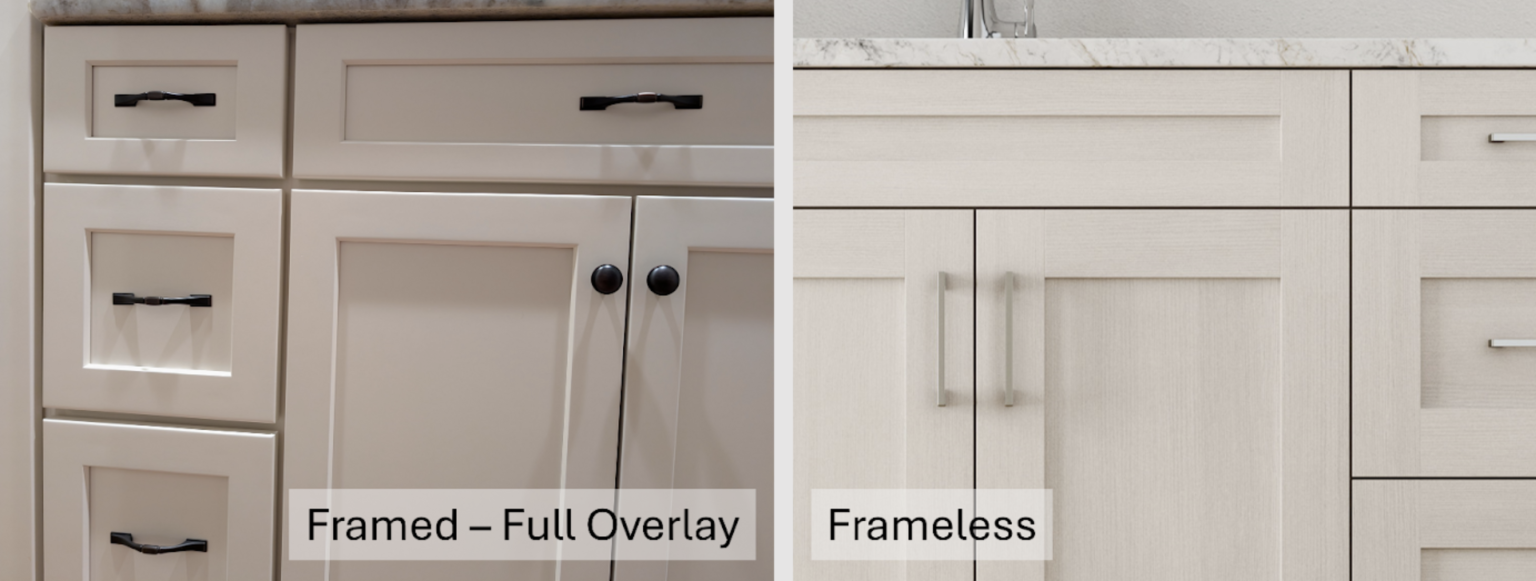
- Full overlay — the door covers most of the frame, typically leaving only about a ¼" of frame visible, for a cleaner, more contemporary look.
- Inset — the door sits flush inside the frame opening, exposing the full frame around it for a classic, furniture-like appearance.
That flexibility is one of framed cabinetry's biggest selling points — you get the traditional look and the option to dress it up with a more modern full-overlay door if you want.
What Are Frameless Cabinets?
Frameless cabinets, often called European-style cabinets, skip the face frame entirely. Doors and drawer fronts attach directly to the cabinet box using adjustable European-style hinges mounted inside the cabinet walls. Without a frame in the way, the entire opening is available for storage, and the doors nearly cover the box edge to edge.
This construction naturally lends itself to a sleek, minimalist, contemporary aesthetic — no visible hinges, no frame lines breaking up the cabinet face, just clean, continuous surfaces. It's why frameless cabinets are the dominant style in Europe and have grown steadily more popular in modern American kitchens.
Unlike framed cabinets, frameless construction only really supports full overlay doors (with inset as a less common option) — there's no frame available to create a standard/partial overlay reveal.
Framed vs. Frameless: Key Differences at a Glance
| Feature | Framed Cabinets | Frameless Cabinets |
|---|---|---|
| Style | Traditional, transitional | Modern, minimalist |
| Door overlay options | Standard, full overlay, or inset | Full overlay (occasionally inset) |
| Interior storage space | Slightly less (frame takes up room) | More — full access to the box |
| Durability | More resistant to racking; frame adds strength | Slightly more prone to racking; relies on thicker box material |
| Installation | Easier — frame acts as an alignment guide | More precise and labor-intensive |
| Cost | Generally more affordable | Generally more expensive |
| Hardware | Sometimes optional with inset styles | Typically required |
| Common finish tolerance | ⅛" reveal is standard | As tight as ⅛" or less between doors |
Frameless vs. Full Overlay: Clearing Up a Common Point of Confusion
A lot of homeowners (and even some designers) use "frameless" and "full overlay" interchangeably — but they're not quite the same thing, and it's worth understanding why.
- Frameless describes the cabinet box construction — whether or not there's a face frame.
- Full overlay describes the door style — how much of the frame (if there is one) the door covers.
Here's the key nuance: you can absolutely have full overlay doors on a framed cabinet. Many manufacturers build cabinets with a face frame specifically so they can offer full-overlay doors that create a nearly frameless look while retaining the frame's structural benefits. So when someone says "frameless" but means "the doors almost completely hide the frame," they may actually be describing a framed cabinet with full overlay doors — not a true frameless box.
If your designer presents your choice as "framed with inset doors" vs. "frameless with overlay doors," they're likely simplifying two of the most common combinations their shop offers, not stating that framed and frameless can only pair with those specific door styles.
Pros and Cons of Framed Cabinets
Pros:
- Superior structural strength and resistance to racking over time
- Three overlay/inset options let you dial in the exact look you want
- Easier and generally more affordable to install
- Well-suited to traditional, transitional, and high-traffic kitchens
Cons:
- The frame reduces usable interior storage space slightly
- Adds a bit of extra thickness/bulk to the cabinet
- May require finished end panels ("skins") for exposed sides
Pros and Cons of Frameless Cabinets
Pros:
- Full, unobstructed access to the cabinet interior
- Larger drawer boxes — often an inch or more of extra width per drawer compared to a similarly sized framed cabinet
- Clean, seamless, contemporary appearance with no visible hinges
- Flexible enough to work in modern or transitional designs
Cons:
- Typically costs more due to the amount and quality of material required
- Slightly less resistant to racking without the frame's added rigidity
- Requires more precise (often professional) installation
- Almost always requires hardware, since gaps between doors are minimal
Cost Comparison
Frameless cabinets tend to run more expensive than framed cabinets. This comes down to a few factors: frameless boxes typically need thicker, higher-quality panel material to stay rigid without a frame, and the tight tolerances required for full-overlay doors demand more precise (and often professional) installation. Framed cabinets, by contrast, are available at a wider range of price points — from stock to semi-custom to full custom — making them a common choice for budget-conscious remodels.
Durability and Structural Support
If long-term durability under heavy daily use is a top priority, framed cabinets generally have the edge. The face frame reinforces the box and helps prevent sagging or racking over years of opening and closing doors and drawers. Frameless cabinets can be just as long-lasting when built from quality materials, but they lean more heavily on the thickness and construction of the box itself, since there's no frame providing extra reinforcement.
Installation Considerations
Framed cabinets are generally easier to install — even DIY-friendly in some cases — because the frame provides a built-in reference point for aligning doors and drawers. Frameless cabinets require tighter tolerances (often as small as ⅛" or less between doors) and precise hinge placement, which usually means professional installation to avoid doors that rub or bind against each other.
How to Choose the Right Cabinet Style for Your Kitchen
Ask yourself these questions:
- What's your design aesthetic? Leaning modern and minimal → frameless. Leaning traditional or transitional → framed.
- How much storage do you need? If maximizing every inch of cabinet interior matters (especially in a smaller kitchen), frameless cabinets offer more usable space.
- What's your budget? Framed cabinets are usually the more affordable route, especially in stock or semi-custom lines.
- How much wear and tear will your kitchen see? High-traffic households may benefit from the added durability of a framed design.
- Do you want overlay flexibility? If you like the idea of comparing partial overlay, full overlay, and inset side by side, framed cabinets give you that choice.
Frequently Asked Questions
Is full overlay the same as frameless?
No. Frameless describes the box construction (no face frame), while full overlay describes a door style that can be applied to either framed or frameless cabinets.
Are frameless cabinets less sturdy than framed cabinets?
They can be slightly less resistant to racking since they lack a reinforcing frame, but high-quality frameless construction with thick panel material holds up very well over time.
Can I get full overlay doors on framed cabinets?
Yes. It's actually one of the most popular ways to get a clean, modern look while keeping the structural benefits of a face frame.
Which is more expensive, framed or frameless?
Frameless cabinets are typically the pricier option due to material and installation precision requirements, though the exact cost depends on materials, finishes, and whether you choose stock, semi-custom, or fully custom cabinetry.
The Bottom Line
There's no universally "better" option between framed and frameless cabinets — only what's better for your kitchen. If you want a sleek, contemporary look with maximum interior storage and don't mind a higher price tag, frameless cabinetry is likely your best fit. If you value structural durability, installation ease, and the flexibility of multiple overlay styles at a friendlier price point, framed cabinets are the way to go.
At US Kitchen Cabinet, we offer both framed and frameless cabinetry, tailored to your style, storage needs, and budget. Whether you're renovating a modern kitchen or upgrading a classic one, our team can help you find the construction style and door overlay that brings your vision to life. Contact us today to get started.